Wireless Digital Twin Calibration:
Refining DFT-Domain Channel Information

Asilomar Conference on Signals, Systems, and Computers, 2026

Hao Luo1, Saeed R. Khosravirad2, and Ahmed Alkhateeb1

1Wireless Intelligence Lab, Arizona State University, USA

2Nokia Bell Laboratories, Murray Hill, NJ, USA

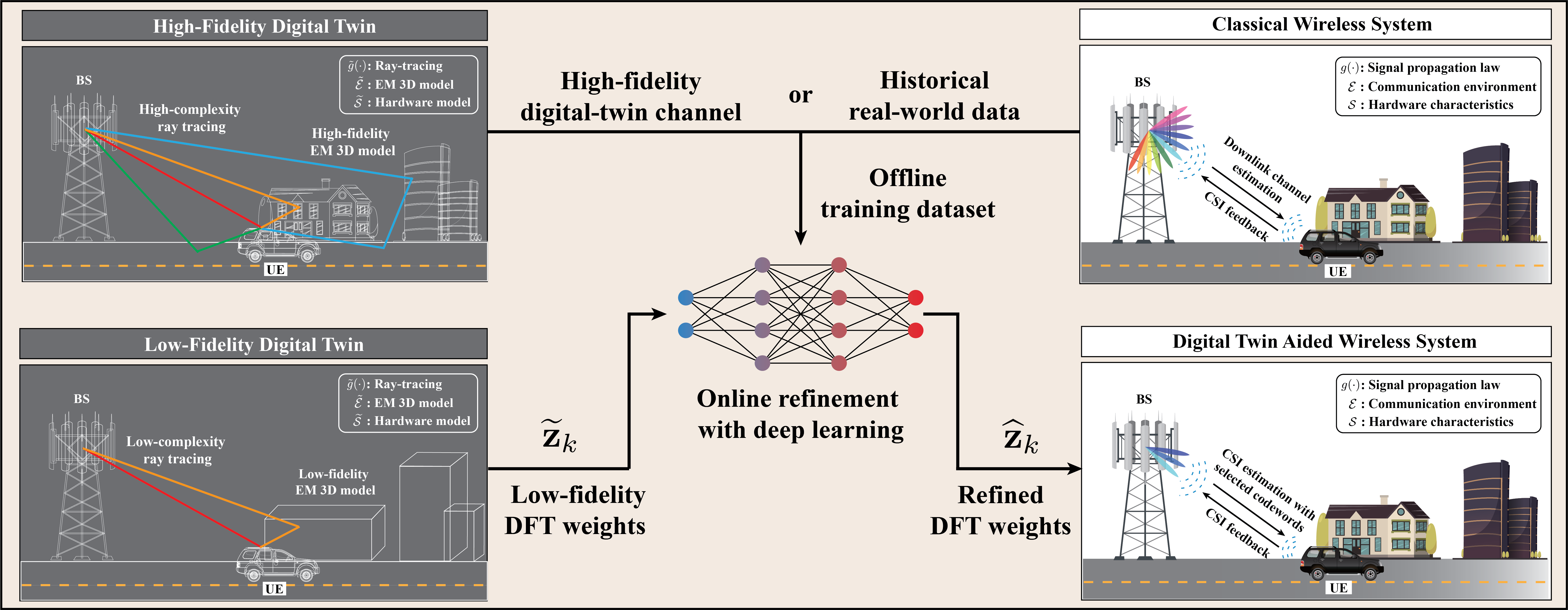
Fig. 1. This figure illustrates the proposed digital twin calibration framework and its use case of codebook-based CSI feedback. The BS generates synthetic channel information for a user using a low-fidelity digital twin. The synthetic channel information is then refined using a lightweight deep learning model. The refined channel information is used to select the most relevant DFT codewords for that user. The user receives pilot signals corresponding to these selected codewords and estimates their coefficients, which are reported back to the BS for downlink precoder design.

Abstract

Wireless digital twins can be leveraged to provide site-specific synthetic channel information through precise physical modeling and signal propagation simulations. This can help reduce the overhead of channel state information (CSI) acquisition, particularly needed for large-scale MIMO systems. For high-quality digital twin channels, the classical approach is to increase the digital twin fidelity via more accurate modeling of the environment, propagation, and hardware. This, however, comes with high computational cost, making it unsuitable for real-time applications. In this paper, we propose a new framework that, instead of calibrating the digital twin model itself, calibrates the DFT-domain channel information to reduce the gap between the low-fidelity digital twin and its high-fidelity counterpart or the real world. This allows systems to leverage a low-complexity digital twin for generating real-time channel information without compromising quality. To evaluate the effectiveness of the proposed approach, we adopt codebook-based CSI feedback as a case study, where refined synthetic channel information is used to identify the most relevant DFT codewords for each user. Simulation results demonstrate the effectiveness of the proposed digital twin calibration approach in achieving high CSI acquisition accuracy while reducing the computational overhead of the digital twin. This paves the way for realizing digital twin assisted wireless systems.
Simulation Results

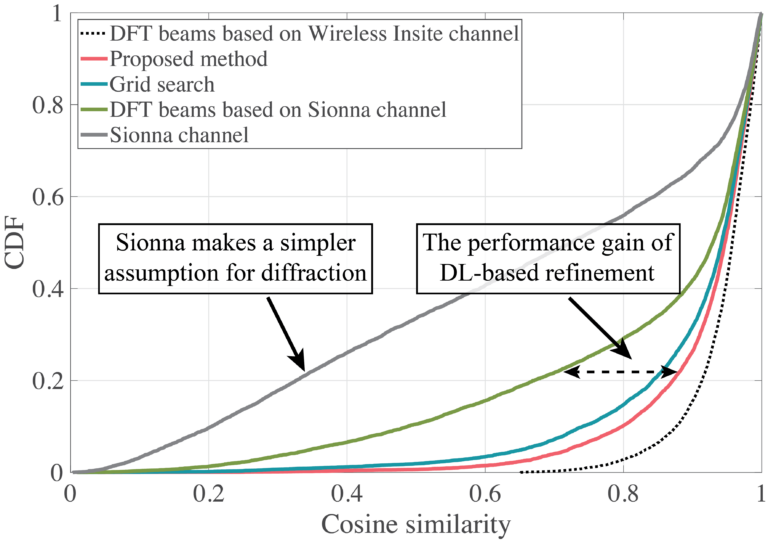
Fig. 2. This figure presents the CDF of the cosine similarity between the ground-truth channel and the estimated CSI using the top-4 DFT beams selected by the proposed calibration approach and the benchmark scenarios. By integrating a lightweight calibration model (inference: 0.0018 s/sample), our approach nears the performance upper bound while maintaining a total cost of 0.0610 s/sample, which is significantly lower than the 1.2019 s/sample required by a high-fidelity digital twin

Citation

If you want to use the dataset or scripts in this page, please cite the following paper:

H. Luo, S. R. Khosravirad, and A. Alkhateeb, “Wireless digital twin calibration: Refining DFT-domain channel information,” arXiv preprint arXiv:2603.16126, 2026.

@article{Luo2026,
title={Wireless digital twin calibration: Refining dft-domain channel information},
author={Luo, Hao and Khosravirad, Saeed R and Alkhateeb, Ahmed},
journal={arXiv preprint arXiv:2603.16126},
year={2026} }