Generative Decoding of Compressed CSI
for MIMO Precoding Design

IEEE International Conference on Communications (ICC), 2026

Hao Luo1, Saeed R. Khosravirad2, and Ahmed Alkhateeb1

1Wireless Intelligence Lab, Arizona State University, USA

2Nokia Bell Laboratories, Murray Hill, NJ, USA

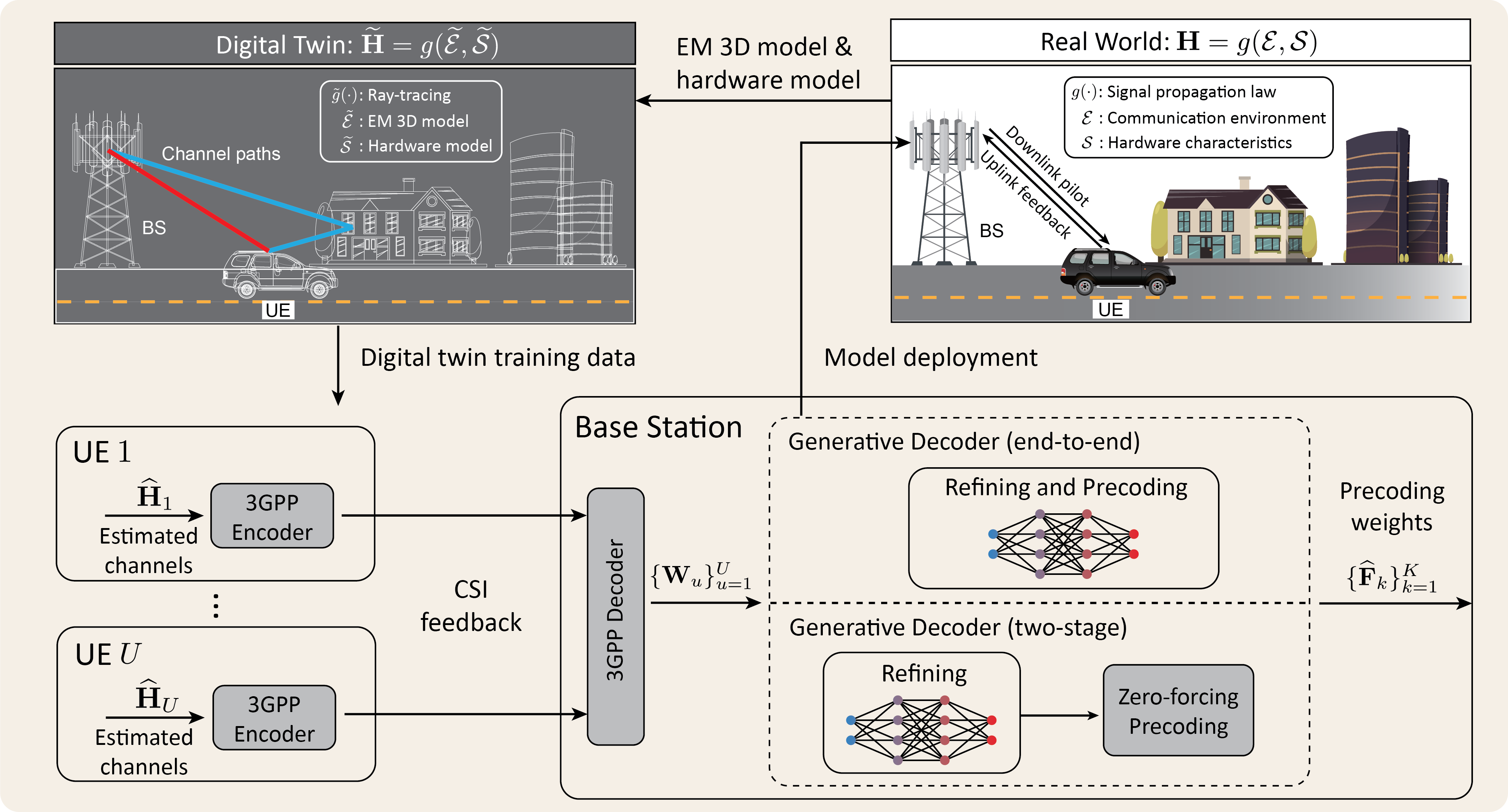
Fig. 1. This figure presents the key ideas of the proposed generative decoder solution. The estimated channel is compressed using a standardized encoder on the UE, and a generative decoder refines the reported CSI at the BS. A site-specific digital twin is also leveraged to generate synthetic data for offline training, and the trained generative decoder can be deployed in the real-world system with high performance.

Abstract

Massive MIMO systems can enhance spectral and energy efficiency, but they require accurate channel state information (CSI), which becomes costly as the number of antennas increases. While machine learning (ML) autoencoders show promise for CSI reconstruction and reducing feedback overhead, they introduce new challenges with standardization, interoperability, and backward compatibility. Also, the significant data collection needed for training makes real-world deployment difficult. To overcome these drawbacks, we propose an ML-based, decoder-only solution for compressed CSI. Our approach uses a standardized encoder for CSI compression on the user side and a site-specific generative decoder at the base station to refine the compressed CSI using environmental knowledge. We introduce two training schemes for the generative decoder: An end-to-end method and a two-stage method, both utilizing a goal-oriented loss function. Furthermore, we reduce the data collection overhead by using a site-specific digital twin to generate synthetic CSI data for training. Our simulations highlight the effectiveness of this solution across various feedback overhead regimes.

Simulation Results

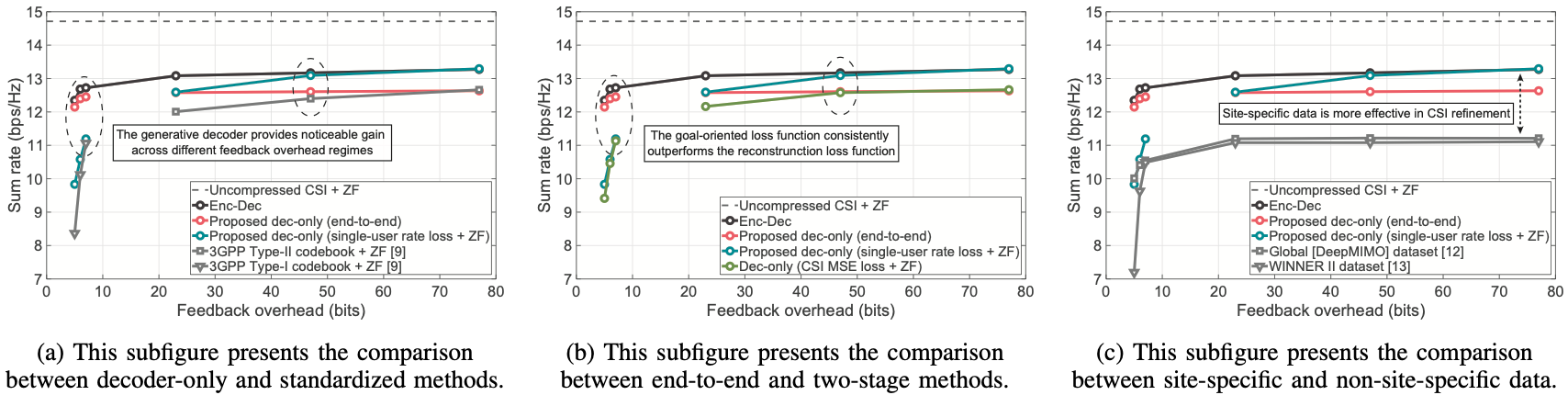
Fig. 2. This figure shows the performance of the generative decoder. The results show its effectiveness by comparing it against codebook-based CSI feedback and a reconstruction loss. The results also emphasize the importance of a site-specific dataset, as shown by the comparison with generic datasets.

Citation

If you want to use the dataset or scripts in this page, please cite the following paper:

H. Luo, S. R. Khosravirad and A. Alkhateeb, “Generative Decoding of Compressed CSI for MIMO Precoding Design,” ICC 2026 – IEEE International Conference on Communications, Glasgow, United Kingdom, 2026.

@INPROCEEDINGS{Luo2026,
author={Luo, Hao and Khosravirad, Saeed R. and Alkhateeb, Ahmed},
booktitle={ICC 2026 – IEEE International Conference on Communications},
title={Generative Decoding of Compressed CSI for MIMO Precoding Design},
year={2026},
pages={1-6}}}